One of the first questions people ask when switching to an electric vehicle is simple: how long will charging actually take? The answer depends on several factors, mainly the type of charger, the vehicle’s battery capacity, its maximum charging rate, and how much charge is already left in the battery. In the UAE, EV drivers have access to different charging options, from overnight home charging to high-power DC chargers designed for much faster stops. Understanding EV charging time in the UAE can help you choose the right charging setup for your daily routine.
What Determines Electric Car Charging Time?
There is no single charging time that applies to every electric car. Two EVs connected to the same charger can take different amounts of time to reach the same battery percentage.
The main factors affecting electric car charging time in the UAE include:
Battery capacity: Larger batteries generally require more energy and can take longer to charge.
Charger power: A higher charging output can deliver more energy to the vehicle in a shorter period.
Vehicle charging capability: Every EV has a maximum AC and DC charging rate. Connecting a car to a charger that exceeds this limit will not make the vehicle accept power beyond its supported rate.
Starting battery level: Charging from 60% to 80% will naturally take less time than charging from 10% to 80%.
Battery temperature and conditions: EV battery management systems can adjust charging speeds depending on battery temperature and other operating conditions.
Charging curve: DC charging speeds are not constant. Many vehicles charge quickly at lower battery levels and reduce the charging rate as the battery approaches a high state of charge.
This is why charger specifications alone cannot tell you exactly how long a specific vehicle will take to charge.
How Long Does Home EV Charging Take?
For most EV owners, home charging is designed around convenience rather than getting the battery from empty to full as quickly as possible.
A dedicated AC home charger can typically charge an EV over several hours, making overnight charging a practical option. Depending on the charger, vehicle and battery size, a typical home charging session may take around 4 to 12 hours.
The important point is that most drivers do not arrive home with a completely empty battery every evening. Instead, they plug in after their daily journeys and replenish the energy they have used.
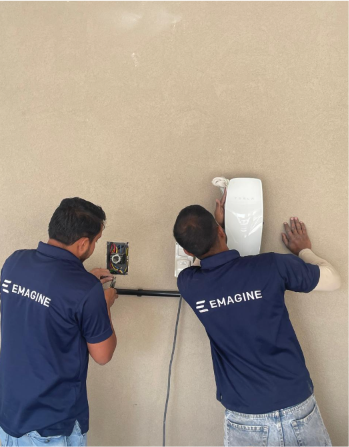
For UAE homeowners looking for a dedicated charging setup, Emagine provides residential EV charging solutions designed around the property, vehicle and electrical requirements.
How Fast Is DC Fast Charging?
DC fast charging is built for situations where drivers need significantly more energy in a shorter period.
Instead of relying on the vehicle’s onboard AC charger, a DC charger delivers power directly to the battery. Depending on the charger and the EV’s supported DC charging rate, many vehicles can add a substantial amount of charge in approximately 20 to 60 minutes.
Some high-power charging systems can be even faster with compatible vehicles.
However, maximum charger output does not automatically equal maximum charging speed. For example, connecting an EV that supports a maximum DC charging rate of 150 kW to a higher-powered charger will not make it charge above the vehicle’s supported limit.
Emagine offers fast charging solutions for locations where shorter charging sessions and higher power are required.
Home Charging vs Fast Charging: Which Takes Less Time?
When comparing EV charging time in the UAE, DC fast charging is clearly the quicker option per charging session.
But speed is only one part of the charging experience.
Home charging allows drivers to plug in while the vehicle is already parked, particularly overnight. The car can spend several hours charging without requiring the driver to wait.
Fast charging serves a different purpose. It is useful for longer journeys, commercial applications, public charging locations and situations where drivers need to get back on the road sooner.
For many EV drivers, the two options complement each other: home charging handles regular daily needs, while fast charging provides additional flexibility when quicker charging is required.
Why Does Charging Slow Down Near 100%?
If you have used a DC fast charger before, you may have noticed that charging becomes slower as the battery fills.
This is normal.
EVs use battery management systems to control how much power the battery accepts. Charging rates can decrease at higher states of charge to manage battery conditions.
As a result, charging from a low battery level to around 80% can often be considerably faster than completing the final portion toward 100%.
For drivers using public fast chargers, this is one reason charging sessions are often discussed in terms such as 10% to 80% rather than 0% to 100%.
Does the UAE Climate Affect EV Charging Time?
The UAE’s climate is another factor worth considering.
Lithium-ion batteries operate within preferred temperature ranges, and EVs use thermal management systems to regulate battery temperature. During particularly hot conditions, the vehicle may adjust charging performance depending on battery temperature and its thermal management capabilities.
This does not mean EV charging is unsuitable for the UAE. It simply makes proper charger selection, installation and electrical planning important for reliable everyday operation.
What Type of EV Charger Do You Need?
The right charger depends on how and where the vehicle will be used.
For a private EV that spends several hours parked at home every night, an AC home charger will often cover everyday charging requirements.
For businesses, fleets, highways, commercial destinations and public charging locations where vehicles need shorter charging sessions, DC fast charging may be more appropriate.
The vehicle itself also needs to be considered. Its battery capacity, AC charging limit and DC charging capability all affect the charging solution that makes sense.
So, How Long Does It Take to Charge an Electric Car in the UAE?
As a general guide:
Home AC charging: approximately 4–12 hours, depending on the vehicle and charger.
DC fast charging: approximately 20–60 minutes for a significant battery recharge, depending on the EV, charger output and battery conditions.
Ultimately, electric car charging time in the UAE is determined by the combination of the charger and the vehicle rather than one fixed number.
Emagine provides EV charging solutions for residential, commercial and fast-charging applications across the UAE. Choosing a charging solution that matches the vehicle, location and expected usage can make EV charging a simple part of everyday driving.